

Technical Audit
Not every technical problem deserves your morning.
A crawl of any real site produces more findings than anyone will ever action. Technical Audit consolidates them by severity and category, so the question becomes which conditions are genuinely holding the site back rather than how long the list is.
No card required.
- Aggregated from your latest scan
- Ranked by severity
- Grouped by category
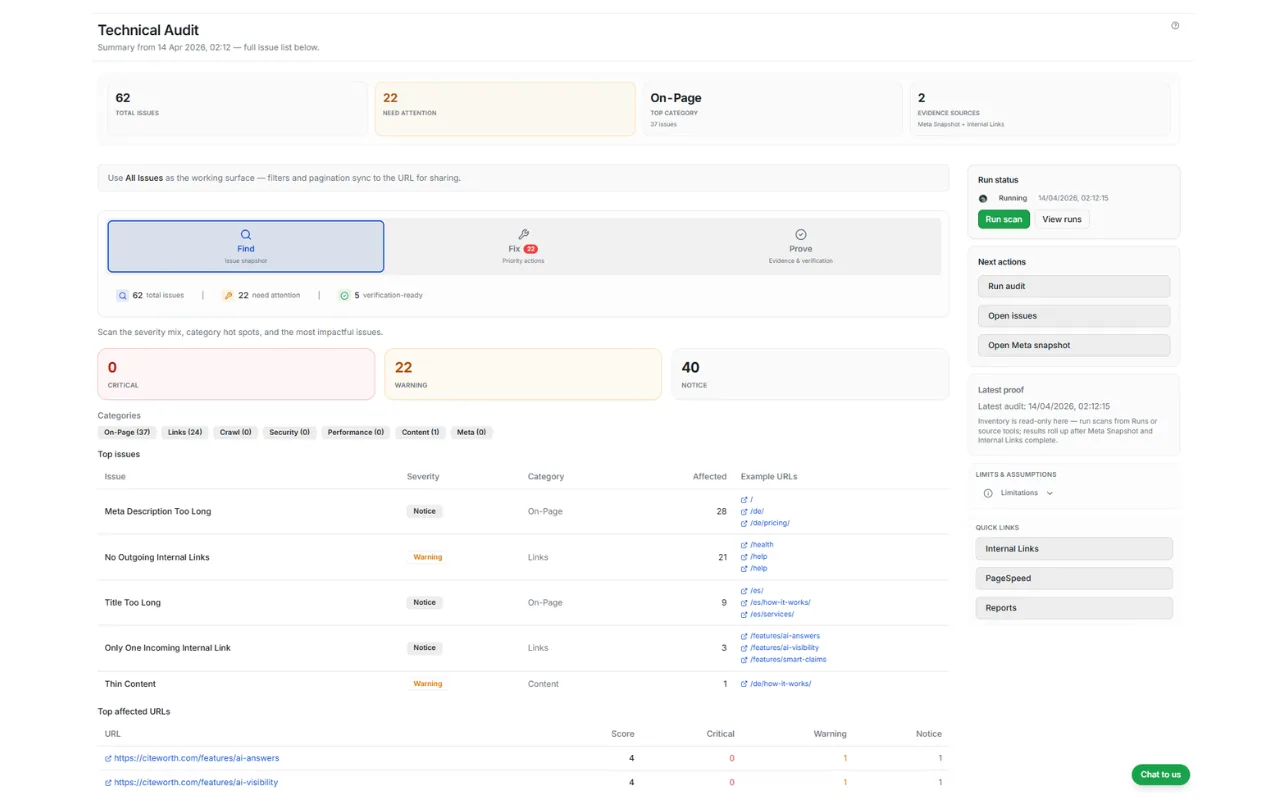
Severity first
A long list is not the same as a serious problem.
On a large site, issue counts look alarming almost by definition — one bad template multiplies across thousands of pages. Severity is what separates a genuine blocker from a repeated cosmetic detail.
- Critical
Conditions that can prevent a page from being reached, indexed or interpreted at all.
- High
Substantial problems that meaningfully degrade how a page is understood.
- Medium
Worth correcting, usually as part of planned work rather than ahead of it.
- Low
Minor and often cosmetic. Real, but rarely the reason anything is going wrong.
Work down from the top. A thousand low findings matter less than one critical one.
Grouped by category
Findings cluster, and the cluster is usually the real story.
Individual issues are rarely independent. Seeing them grouped tends to reveal a single upstream cause — a template, a configuration, a build step — rather than a hundred separate mistakes.
-
Crawlability
Whether pages can be reached and followed in the first place.
-
Schema
Machine-readable markup that is missing, malformed or contradictory.
-
Performance
Conditions that make a page slow or expensive to retrieve.
-
Accessibility
Structural problems that also affect how cleanly content can be parsed.
How this differs from Meta Snapshot
One tells you where to look. The other lets you look.
These two get confused, and using the wrong one wastes time. The distinction is simple once stated.
The aggregate
Technical Audit
Read-only. Shows the distribution of conditions across the site so you can decide where attention belongs.
The investigation
Meta Snapshot
Page-level. Captures what is actually there at a specific URL, once you know which URL matters.
Technical Audit does not change anything. It is a view, not an intervention.
From triage to work
A severity ranking is only useful if something happens next.
Findings worth acting on can be built into an implementation-ready package and committed as work with an owner and acceptance criteria. The point of triage is to reach that decision quickly, not to produce a longer report.
- 01
Triage here
Establish what is serious and what is noise.
- 02
Investigate the target
Confirm the condition at page level.
- 03
Build the work
Turn the finding into something implementable.
- 04
Commit and verify
Own it, ship it, and check the evidence afterwards.
Technical conditions affect whether your pages can be reached and understood. They are not the only thing that determines whether an answer engine draws on you, and clearing them is not a route to guaranteed visibility.
What Technical Audit connects to
Triage sits between the evidence that produced the findings and the work that resolves them.
Find out what is actually urgent.
Run a scan and see the conditions ranked by how much they matter.
Want help reading a large findings list? Talk to us