

Report Centre
Show your work,
and what followed it.
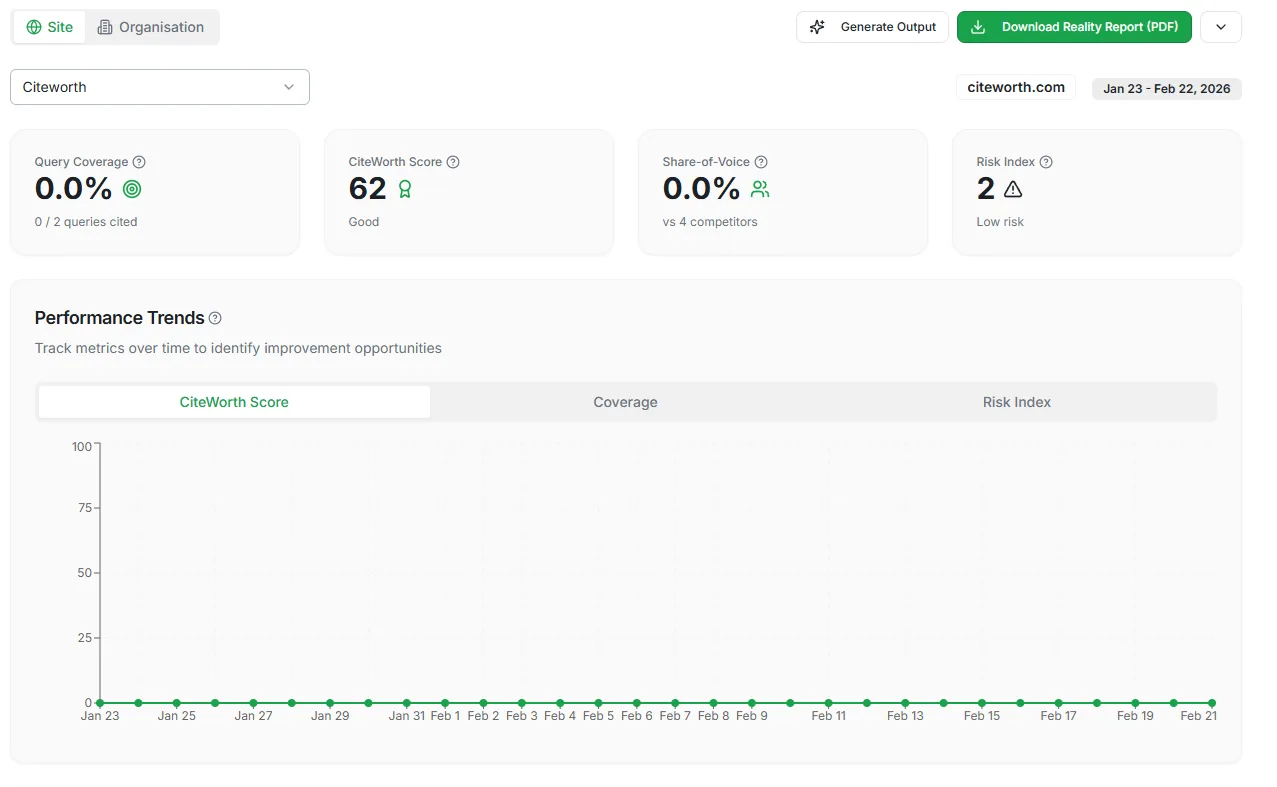
Most reporting asks people to trust a number. Report Centre carries the whole line instead — what the evidence showed, what was decided, what shipped, and what was observed afterwards.
No card required.
- Evidence stays attached
- Before and after
- Built for people outside the tool
What a report carries
A number without its history is just an assertion.
Reports are assembled from work CiteWorth already holds, so the chain stays intact from the first observation to the last. Nothing is retyped, and nothing arrives without its evidence.
- 01
Evidence
What was observed at the outset, across AI answers and the site itself.
- 02
Decision
Which patterns were judged worth acting on, and which were left.
- 03
Work
What was committed to, who owned it, and what actually shipped.
- 04
Observed after
The evidence gathered once the change was live.
Claim discipline
What a CiteWorth report says
CiteWorth proves what changed and shows the evidence observed afterwards.
What it will not say
That a particular change caused an answer engine to start citing you.
Answer engines are not deterministic and do not publish their reasoning. Presenting correlation as causation would make every report you send less defensible, not more. So the sequence is reported honestly — the change, then the evidence that followed — and the judgement is left to the people reading it.
Underneath the summary
The summary is for the room. The detail is there when someone asks.
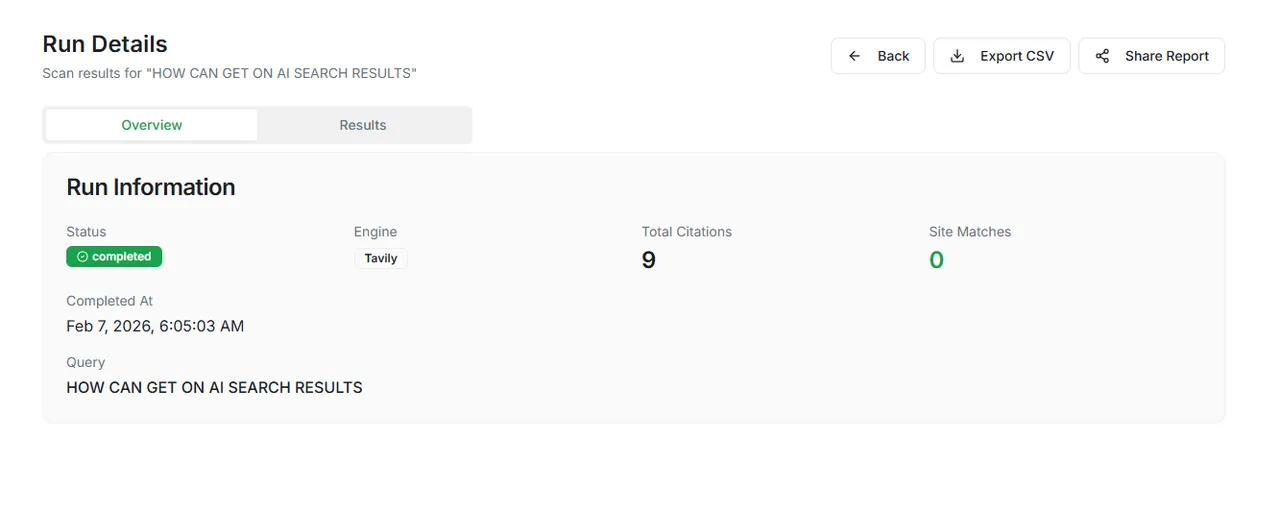
Every headline in a report can be opened up to the per-check results and the run it came from, so a question in a meeting does not become an action item.
-
Per-check results
What each individual check returned, rather than a single rolled-up figure.
-
Run history
Which run produced the result, and how it compares with the runs before it.
-
Linked evidence
A route from any claim in the report back to the observation behind it.
Who reads it
Written to survive the handover.
A report is usually read by someone who was not in the work. The same underlying evidence has to hold up for all of them.
Clients
People paying for outcomes who need to see that the work was real and grounded in something.
Agency teams
Delivery teams carrying several accounts who need consistency rather than bespoke decks.
Stakeholders
Colleagues approving continued investment on the strength of what is shown.
What Reports connects to
Reporting is the last step of a loop rather than a separate exercise, so it draws on everything before it.
Give people the evidence, not just the conclusion.
Run your first evidence pass and see what a report built on it looks like.
Reporting to clients at scale? Talk to us