

Share of Voice
How much of the AI conversation do you own?
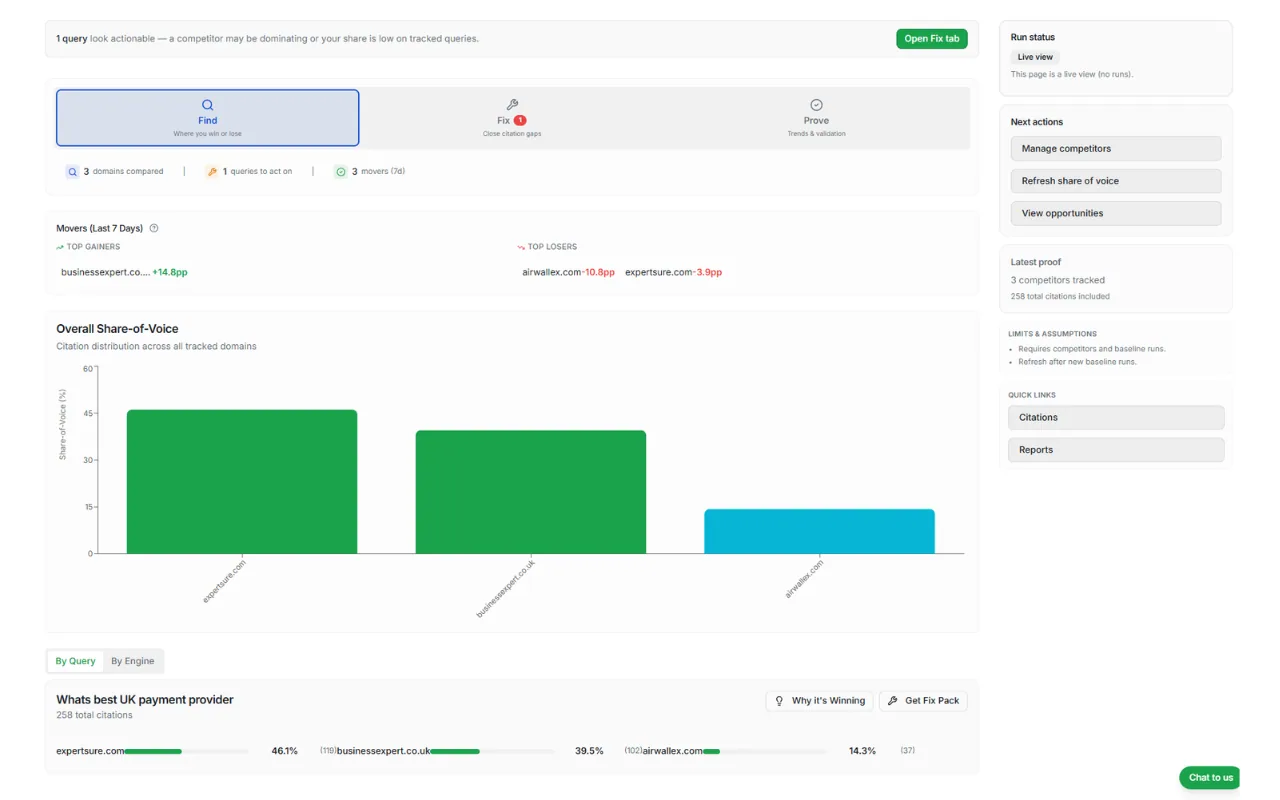
For any question in your category an answer gets built from somewhere. Share of Voice compares how often that somewhere is you against the competitor domains you track — question by question, refreshed with every run.
No card required.
- Compared per question
- Against domains you choose
- Refreshed every run
The shape of the question
Visibility is not a score you hold on your own.
Being cited sometimes sounds fine until you see it next to everyone else being cited for the same question. Share is relative, so it has to be read that way.
-
You
-
Competitor A
-
Competitor B
-
Other sources
Illustrative diagram of citation share for a single tracked question, showing the reader's share alongside tracked competitors and other sources. No values are shown.
Read it per question
An average across your whole question set will hide the thing you needed to see.
Share is calculated against the same questions for every domain, which is what makes the comparison meaningful. It also means the interesting information is at the question level, not in the headline.
-
Where you hold it
Questions you are consistently drawn on for, which are usually worth protecting rather than improving.
-
Where you do not
Questions in your category where the answer is reliably built from somebody else.
-
Where it is moving
Whether the distance on a question is narrowing or widening across runs.
What share does and does not tell you
It tells you
- How often you are drawn on relative to the domains you track
- Which questions are being answered without you
- Whether that picture is stable or moving
It does not tell you
- Why an engine selected one source over another
- That a low share is caused by any particular thing
- What your share will be next month
Answer engines do not publish their reasoning, so share is evidence of what happened rather than an explanation of it. Treating it as a diagnosis is how teams end up fixing the wrong thing confidently.
Where it leads
Share tells you there is a gap. Two other places tell you what to do about it.
What Share of Voice connects to
Share is a comparison, so it only means something alongside the evidence that produced it.
Find out whose answer your customers are reading.
Track a set of questions and see how the share falls across your category.
Not sure which questions to track? Talk to us