

Alerts
The point is not to be told everything.
An alerting system that reports every change becomes a feed nobody reads, which is worse than having none. Alerts is built around the harder question: which of these changes actually warrants interrupting someone?
No card required.
- Change between checks
- Severity context
- Configurable triggers
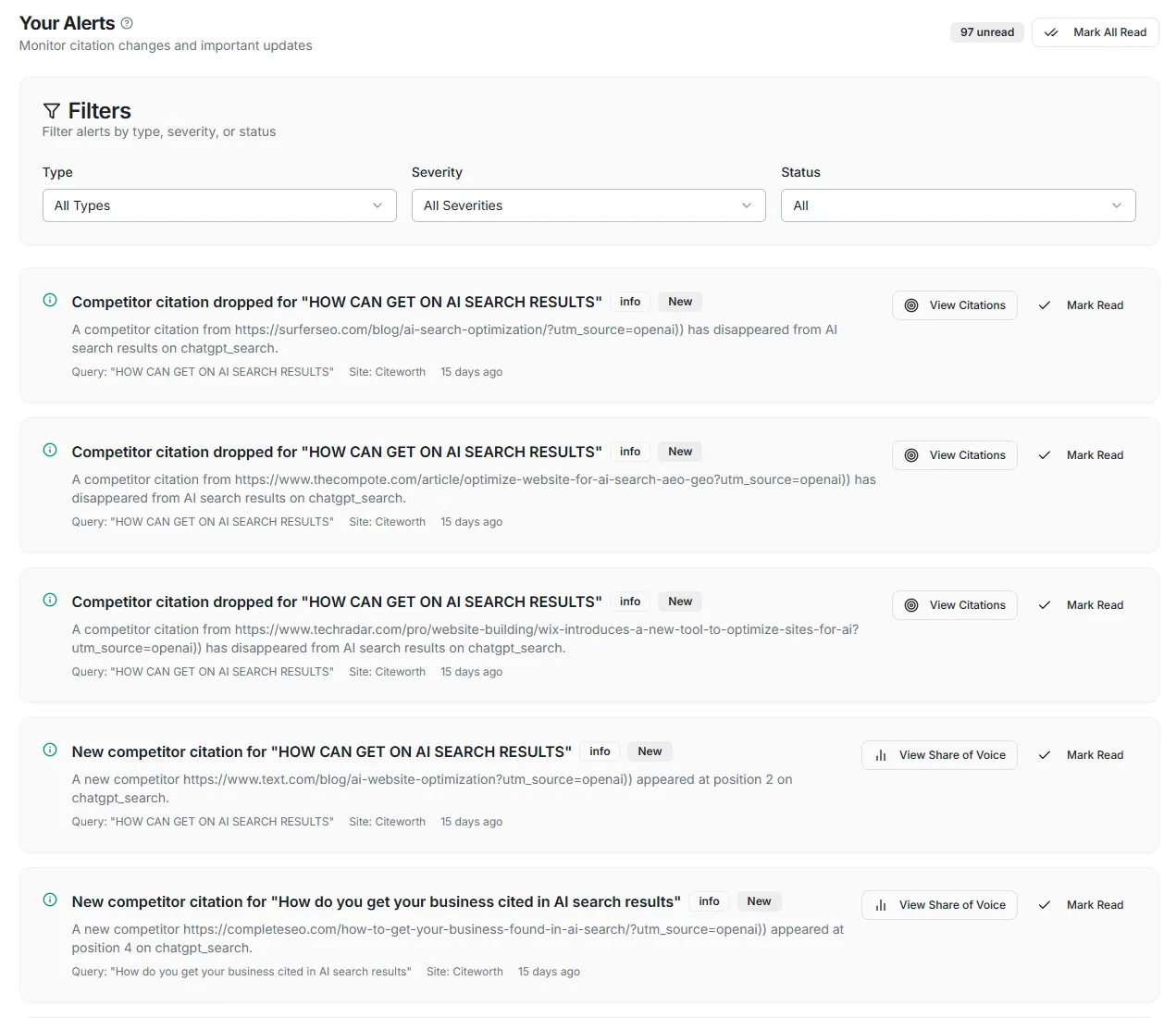
What gets surfaced
Movement, not state.
Every other view in CiteWorth tells you how things are. Alerts only speaks up when something is different from last time, which is a much smaller and more useful set.
-
Citation movement
References appearing or disappearing between checks.
-
New issues
Conditions that were not present in the previous run.
-
Regressions
Something previously resolved that has returned.
-
Technical signals
Changes in the underlying site evidence.
How this actually works
Alerts run at the speed of your checks, not in real time.
This is worth being direct about, because the word invites the wrong assumption. An alert is raised when a check runs and finds something different from the previous one. Nothing is watching your site continuously, so the interval between checks is also the interval within which a change might go unnoticed.
-
Checks come first
Alerts are a product of the scan process. Without checks running, there is nothing to compare.
-
Detection follows cadence
A change is found when the next check runs, not at the moment it happens.
-
Not a guarantee
This surfaces changes it observes. It is not an assurance that every change will be caught.
The real design problem
Every alert you ignore makes the next one easier to ignore.
Alert fatigue is not a minor annoyance — it is the failure mode. Once a feed is noisy, the genuinely important entry arrives into an environment where nothing is read.
Worth an interruption
Something changed that alters what you would do today.
Worth a glance later
Something changed that is real, but does not change any decision.
Turning on every trigger available is the most reliable way to make the whole feed worthless. Start narrow and add.
Reading low-severity movement
Minor entries are still worth periodic review, because a pattern of small changes in one area often means more than a single larger one elsewhere. Ignore individual noise, but not the shape it forms over time.
What Alerts connects to
Alerts is a notification layer over evidence that is produced elsewhere.
Be told the things that matter.
Set up checks and decide what deserves your attention.
Want help tuning what should trigger? Talk to us