

Claim Cards
Govern what your business asserts.
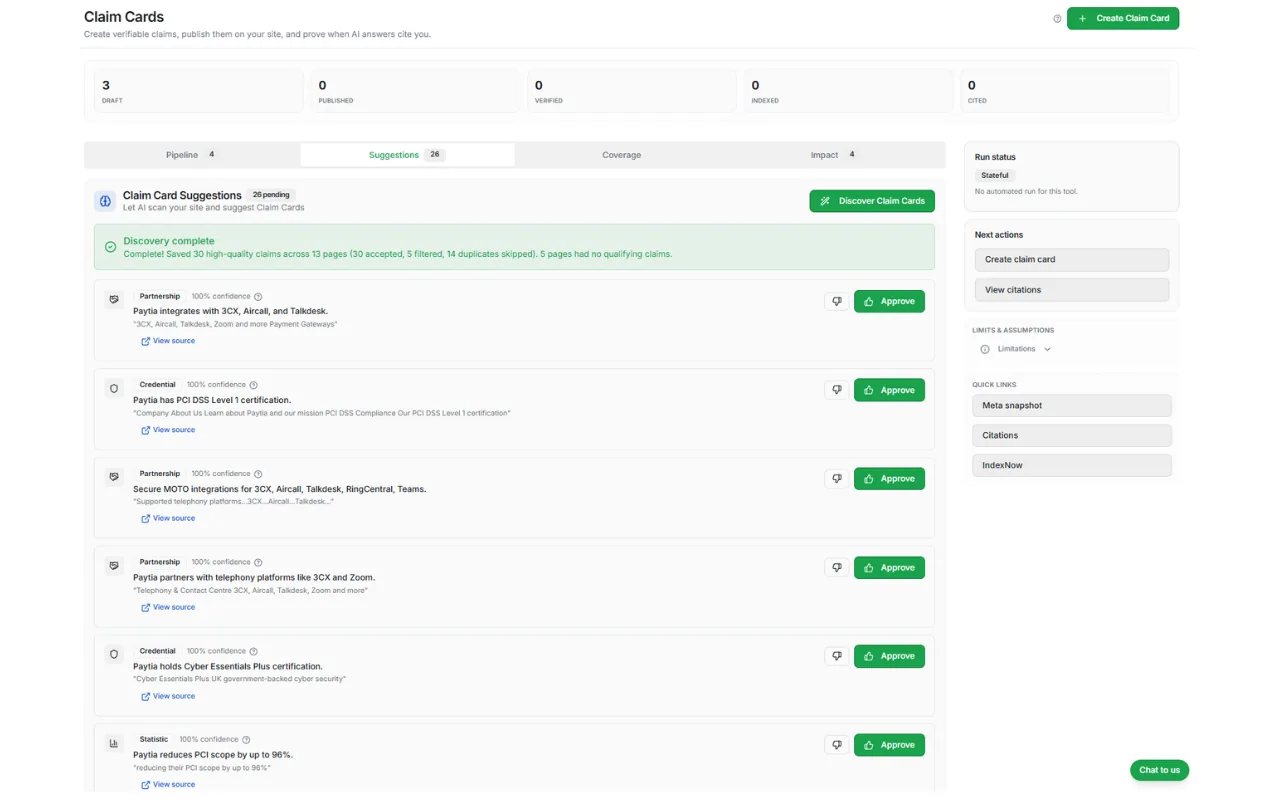
Most organisations repeat important claims everywhere and hold the evidence for them nowhere. Claim Cards give a statement a structure: what is being asserted, what supports it, and whether anyone has checked it lately.
No card required.
- Structured claim assets
- Supporting sources attached
- Reviewable rather than assumed
Why this exists
An unsupported claim is a liability that reads like a strength.
The statements a business leans on tend to live in slide decks, landing pages and sales conversations rather than anywhere they can be checked. Nobody is being dishonest. The support simply drifts away from the sentence.
-
It gets repeated
A claim that sounded reasonable once is reused across pages, campaigns and answers to customers until it reads as settled fact.
-
Its support goes missing
The source that justified it is in someone's inbox, or was true two years ago, or was never written down at all.
-
Nobody owns the check
Because the claim is not held anywhere in particular, no one is responsible for asking whether it still holds up.
Anatomy of a claim
The statement and its support, held as one object.
A claim card keeps the assertion and the material behind it together, so reviewing a claim does not mean reconstructing where it came from.
-
01
The assertion
The statement itself, written once and kept in a single place rather than paraphrased differently everywhere it appears.
-
02
Supporting sources
The references and scan context that justify it, linked to the claim rather than stored separately from it.
-
03
Review state
Whether the claim is settled or still needs a look, so a weak claim is visible as weak instead of quietly passing as final.
A claim card records what your organisation asserts and what supports it. It is an internal governance asset, not an external verification.
Where claims come from
Usually because the evidence pointed at a gap.
Claim Cards are not a blank form to fill in. In practice a card tends to start because something in CiteWorth showed that an assertion your business depends on is not well supported.
From Opportunities
An assertion gap
A claim your business depends on has no strong supporting content behind it, so it arrives here to be governed properly.
From Intelligence Library
Your stated positioning
Claims are held against the positioning you have already set out, rather than against generic category language.
Into Content Studio
Content that has to exist
Where a claim needs supporting material produced, the work carries the evidence and context with it.
Scope
What a claim card is not.
Claim Cards improve how your organisation holds its own statements. That is a governance benefit, and it is worth being precise about where it stops.
-
A truth certification
It records your assertion and its support. It does not certify that the assertion is correct.
-
Acceptance by AI systems
Structuring a claim does not oblige any answer engine to adopt, cite or agree with it.
-
A publishing pipeline
A claim card is held in CiteWorth. Publishing anywhere remains your decision and your workflow.
-
A substitute for judgement
Confidence and review states support a human review. They do not replace one.
Where teams go wrong
- Building cards from stale or weak findings, so the structure lends false weight to a thin claim.
- Treating a draft claim as final because it now looks tidy.
- Creating many low-value claims instead of governing the few the business actually depends on.
What Claim Cards connects to
Governing a claim matters because of what raised it and what gets produced afterwards.
-
Raises it
Opportunities
Surfaces the assertion gaps worth governing in the first place.
-
Gives it context
Intelligence Library
The positioning and business context a claim is held against.
-
Produces from it
Content Studio
Turns a supported claim into the content the evidence says is missing.
-
Tracks the work
Cases
Committed work with an owner and a verification step at the end.
Find out which of your claims are actually supported.
Run an evidence pass and see where the statements your business depends on have nothing holding them up.
Want to talk it through first? Talk to us